Milan, February 19, 2026
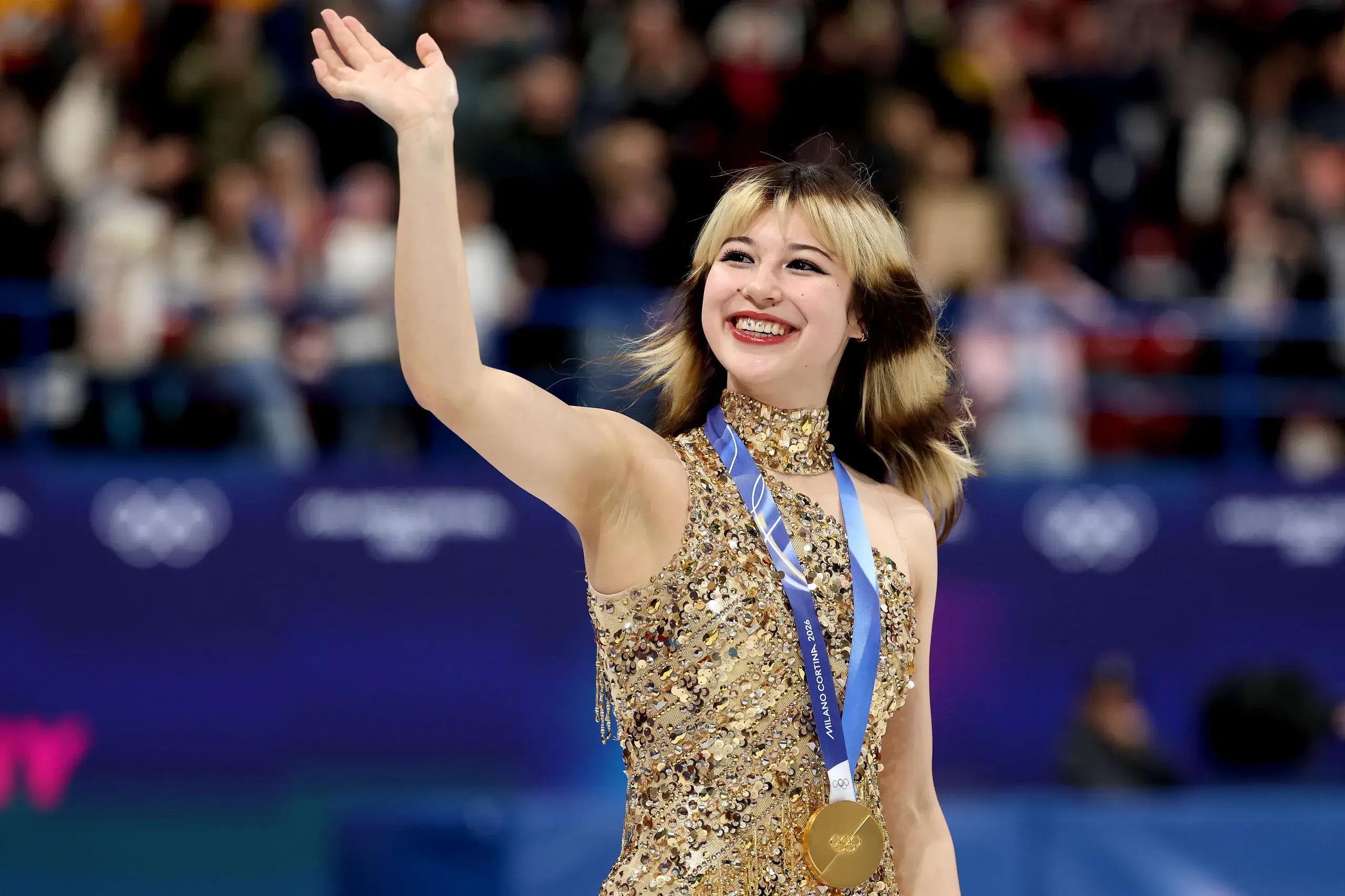
The arena is full. The crowd in Milan has been waiting all night. The short program was two days ago, and Alysa Liu the twenty-year-old American, daughter of a Chinese dissident, former child prodigy, recent college student is sitting in third place going into the free skate. Close enough to the top to matter. Far enough back to need something special tonight.
She walks onto the ice in a dress she designed herself. Gold, sparkling, made for the music she's about to skate to.
She doesn't look nervous.
In the minutes before the skate, she has been doing things that make the commentators uneasy. She's taken pictures of her coaches. She's done a live television interview with NBC's Andrea Joyce. She's waved at people in the upper seats. These are not the things elite skaters do in the last minutes before competing for Olympic gold.
The music starts synths, horns, a soaring disco arrangement. Donna Summer's “MacArthur Park Suite,” a 1978 track her coach discovered and handed to her the previous year. She had never heard of it before. She fell in love with it after listening once.
She dances.
She isn't just skating. She's performing. In the middle of her transitions she looks up and smiles at people in the upper rows. She shows off her dress. Every jump, every spin, every piece of choreography she approved herself, months ago, she lands it all.
When the final pose comes, she holds it for just a second, then erupts. The crowd is already on its feet. She yells something she wouldn't want her father to hear.
The score flashes: 226.79.
First place. First American woman to win Olympic gold in women's figure skating since Sarah Hughes at Salt Lake City in 2002. A twenty-four-year drought, ended.
Someone asks her later what she was thinking about at the end, when she must have known she was going to win.
“I was not thinking about the score. I was just still kind of in that; oh, I just skated my life out right now.”
- Alysa Liu, minutes after her gold-medal free skate
To understand why she's smiling like that like someone who has just solved something she's been working on her whole life, you have to go back three years, to a dorm room in Colorado Springs.
The Dorm in Colorado
Three years before Milan, Alysa Liu was fifteen years old, living alone at the U.S. Olympic Training Center in Colorado Springs.
This is how she described it later:
“I would live at the Olympic Training Center in Colorado, in a dorm by myself. I would eat their food. I went to the rink, skated, ate lunch there, skated some more. Went back to the dorm. I didn't go anywhere. I didn't see anything. I was just there.”
She was preparing for Beijing. She had been, at the age of thirteen, the youngest U.S. women's national champion in the sport's history. She had landed a triple axel younger than any American woman ever had. She would become the first American woman to land a quadruple jump in competition. By every external measure, she was one of the most extraordinary young skaters the country had produced.
And she hated it.
“I was in fight-or-flight mode all the time. I didn't enjoy being at the rink from seven a.m. to seven p.m. every day.”
- Alysa Liu
Her father, Arthur Liu, had come to America in 1989 as a Chinese dissident, one of the students smuggled out after the Tiananmen Square crackdown. He had noticed his daughter's gift when she was five and had quietly reorganized the family's life around developing it. He spent, by some reports, close to a million dollars. He fired coaches. He moved her across the country for training. He was, as she later described him, not unkindly her business partner as much as her father.
She was good because he had made her good. And somewhere along the way, the thing that had made her love skating in the first place had disappeared.
“I didn't want to let anybody down. But when COVID hit, I did not care anymore.”
At the 2022 Beijing Olympics, she finished sixth. Four months later, she announced she was done. She was sixteen. A year earlier she had admitted, plainly, that she really despised skating.
“I was done a year before I quit. I knew I wanted to be done way before I actually announced my retirement.”
Two Years of Not Being a Skater
For the first time since she was five years old, her mornings belonged to her.
She got her driver's license. She drove her four younger siblings to school. She enrolled at UCLA and took psychology classes. She traveled; not for competitions, but for herself. She flew to Nepal. She hiked the trails around Mount Everest. She went backpacking with friends, stayed up late, did the ordinary things she had never had time for.
She didn't skate. She didn't miss skating. The rink had become a place of pressure and loneliness, and she was done with it.
Then, in January 2024, two years into her retirement, she took a ski trip.
The Ski Trip
She had never skied before in her life. Her coaches, back when she had coaches, had forbidden it, one bad fall and her skating career could have been over.
She went to Lake Tahoe with her best friend, Tseh Newton.
Tseh remembers the drive up the mountain: Alysa in the passenger seat, half-joking, half-serious, announcing she was going to do a black diamond run on her first day. (She did.)
All day long she skied. Cold air on her face. Tired legs. The quiet hum in the chest that comes from going very fast down a mountain. The snow, the speed, the silence between trees. She'd forgotten what it felt like to move her body just for the sake of moving it.
And somewhere on that mountain, or in the car on the way home, or later that night she can't say exactly when, something broke open.
“It was my first time ever, and it was so similar to figure skating. You're cold, your legs are tired, your adrenaline is up, and you're going really fast. And I loved it. I love to ski.”
- Alysa Liu
And then the thought came, unbidden:
“Huh, that's weird. Why do I hate skating but love to ski? That doesn't make sense. So I tested out my theory. I went to the rink. And I loved to skate.”
She hadn't hated skating. She had hated what skating had become.
The Test
The first time back at the rink, she couldn't go alone. It felt, she said, traumatizing. Tseh had to come with her.
She stepped onto the ice the way you'd step onto a floor you'd been afraid of. Tentatively. She had no goals for the session. She only wanted to see if the ice still felt like anything to her.
She tried a double axel.
She landed it.
“I was like, ‘oh.’”
- Alysa Liu, on the moment she realized she could still skate
She and Tseh had made a quiet deal that morning. Tseh remembered it later:
“She was like, I'll just try going to the rink with you in the morning. And if I can land all my drops, I'll come back. And I was like, okay, let's do it. She kind of unsurprisingly was able to pick them all up within the morning.”
She went back the next week. And the week after that. Slowly, the rink stopped feeling like the prison she'd escaped. It began to feel like a blank canvas she was allowed to draw on, just for herself.
The Phone Call
On February 21, 2024, she picked up the phone and called her former coach, Phillip DiGuglielmo.
“I just want lessons. Let's see where this takes us.”
He was alarmed. She had retired at sixteen as a two-time U.S. champion and world bronze medalist. As comeback stories go, it was a complete one. The risk of trying again was enormous: if she failed, she'd spend the rest of her life being the skater who had quit, come back, and failed.
“Please don't,” he said. “Respect your legacy.”
They got on a Zoom call. It lasted two hours. He has since admitted, cheerfully, that he had several glasses of wine over the course of it. She talked him into it.
On March 1, 2024, she announced her comeback on Instagram:
“It was good for me to take time off from skating, and I am beyond excited to begin skating again with my newly found perspective.”
She was eighteen. She had been away for two years. She had a sixteen-minute disco song from 1978 she'd never heard before handed to her by her coach that she was already in love with. She had her own choreography. Her own costumes. And, most importantly, her own reasons.
The Wins Start Arriving
In October 2024, she won the Budapest Trophy. It was her first international event in more than two years. The jumps weren't fully rotated. The rust showed. She won anyway.
In January 2025, she returned to U.S. Nationals in Wichita, Kansas, for the first time in three years. She skated her short program to a score of 76.36, beating the favorite. Afterward, reporters wanted to talk about placement and odds and the Olympics.
She talked about something else:
“I was emotional from the very beginning to the end, and I really love that for me. I felt very connected to the ice.”
- Alysa Liu, after her return to U.S. Nationals
Notice what she didn't say. She didn't say she was pleased with the score. She didn't say she had beaten the favorite. She said she felt connected to the ice. That was the measure that mattered to her now.
Two months later, at the 2025 World Championships in Boston, she turned a cartwheel on the entrance walkway before taking the ice, a gesture that would have been unimaginable from the first version of her. Then she went out and won. First American woman to take the world title since 2006.
The Crisis Before Milan
In September 2025, two months before the Olympics, she had to throw out her entire short program.
She'd been building a routine around “This Is How It Feels” by Icelandic artist Laufey and American artist d4vd. Then d4vd became the subject of a police investigation, the body of a missing teenager had been found in a Tesla registered to him. She and her team scrapped the program within days.
She tried a Lady Gaga medley. It didn't work. Eventually she settled on another Laufey song, “Promise.” She had weeks, not months, to build a new short program before the biggest competition of her life.
The old Alysa the one from the dorm in Colorado, might have unraveled under that kind of pressure. The new one didn't. The rink was the rink. The point wasn't the program. The point was being out there.
Back to Milan
She arrived in Italy already an Olympic champion. On February 8, Team USA had won gold in the team event her first Olympic medal of any color.
But the individual competition was the one that mattered. On February 17, her short program to “Promise” put her in third place. Two Japanese skaters, Kaori Sakamoto and Ami Nakai had outscored her.
Two days later, she walked into the arena for the free skate knowing she needed something extraordinary to take gold.
What followed is everything this story had been building toward.
The warm-up, during which she takes photos of her coaches and chats on camera with NBC.
The gold dress she designed herself.
Sixteen minutes of disco, compressed into four minutes of skating.
The smiles at people in the upper seats of the arena.
The near-perfect landings, part of a remarkable streak. Across her entire comeback, she has completed 221 jumps in 150 jumping passes without a single fall.
The final score: 226.79. Enough to leap from third to first, and to end a drought older than she was.
And that quiet line afterward: “I was not thinking about the score.”
What She Actually Said
Over the following days, as the world tried to understand what it had just watched, Alysa kept trying to explain. She didn't use complicated language. She kept saying things that sounded almost too simple:
“Medals do not validate me in any way; that's not how I feel validation. I give myself validation when I have a sheet of ice or a dance room to do what I love to do.”
- Alysa Liu
“I was peak happiness when I was out there on the ice. Nothing could bring me higher than that.”
- Alysa Liu
Chris Schleicher, a former figure skater writing for Slate, watched the performance and wrote what most commentators had been circling around: Alysa seemed to be skating from a pure place of joy, rather than fear. Most elite skaters, at that level, are terrified. She looked like she was playing.
Aly Raisman, the American gymnast who had flown to Milan to watch, put it another way. When you love something, she said, and when you love yourself, anything is possible.
Two Days Later
At the exhibition gala on February 21, Alysa came out in a sparkly blue dress, her hair in its signature streaks. No scores. No pressure. Just a performance for the crowd.
Her music was “Stateside” by PinkPantheress and Zara Larsson, a song made by and for people her age. She danced across the ice more than she skated it. She performed for the fun of performing.
PinkPantheress, watching online, wrote simply: “UGH SHE'S SO FAB.”
This was the version of skating Alysa had finally arrived at. The version that had nothing to do with proving anything, or escaping anything, or earning anything. The version she had discovered, quietly, on a ski trip in Lake Tahoe in January 2024, when she realized she didn't actually hate skating. She had only hated what it had become.
What Remains
She won the 2026 Olympic gold. She ended a twenty-four-year drought. She made a forty-seven-year-old Donna Summer song jump 976% in streams in forty-eight hours and gave Donna Summer a fourth posthumous number one. The songwriter Jimmy Webb wrote her a personal thank-you note.
But if you asked her, the record that mattered wasn't on any scoreboard.
It was this:
A girl who had started skating at five because her father thought she had a gift for it. Who became the best in the country at thirteen. Who discovered at fifteen that she had built a life she didn't want. Who walked away at sixteen. Who spent two years becoming a normal person a college student, a big sister, a traveler, a skier and who came back at eighteen for one reason only.
She missed the ice.
Not the medals. Not the records. Not the applause.
The ice.
When she came back, that was what she skated for. The rest followed on its own.
THE RECORD
First American woman to win Olympic gold in women's figure skating in 24 years.
Milano Cortina 2026 · Free Skate Score 226.79 · February 19, 2026
But the real record is simpler than that: she remembered what she actually loved, and went back just to do it. Everything else was a gift.

Discussion